



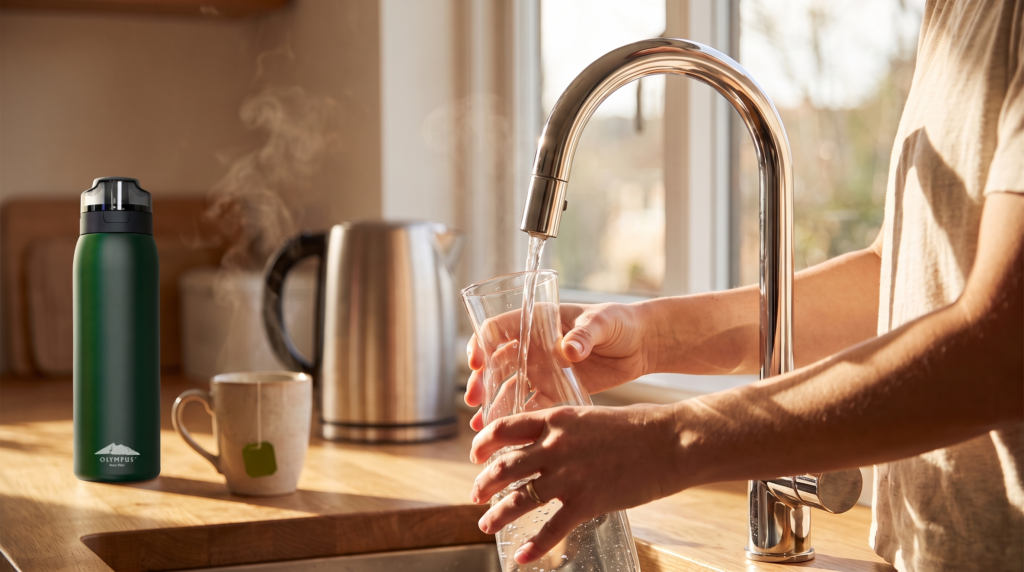
At first glance, a filter pitcher and a faucet filter do the same thing: they run water through a cartridge and return it with better taste. The difference isn't in what they filter, but in how much, how, and for how long.
Most of the questions we get about water filters start here. We've put them in one place, with straightforward answers, so you can decide for your kitchen without reading ten pages of specifications.
What does a filter jug actually do?
A filter jug filters water as you pour it, through a small cartridge placed in its lid. You fill the top, the water passes through the cartridge and collects at the bottom. It's a tabletop solution: it takes up space in the refrigerator, doesn't require installation, and can be purchased at any hypermarket.
It is suitable for those who drink little water at home or want a simple step, without any modifications to the tap.
And a faucet filter?
A faucet filter connects directly to the water source and filters on demand, in the flow. You turn on the tap, the water comes out filtered, in the amount you need: for drinking, for cooking, for tea, for the baby.
Olympus Countertop Water Filter is the typical example: it is mounted on the kitchen faucet, has a ceramic cartridge with activated carbon and costs 77 €, with the first replacement cartridge included.
How much water does each filter filter before changing the cartridge?
Here's the first big difference. The cartridge in a cup is small, because it has to fit into a lid, and it's changed frequently.
The Olympus countertop filter cartridge has a lifespan of up to 12 months or 8,000 liters, sized for a family of up to 5 people. The GIGA variant reaches 14,000 liters. Basically, you change it once a year.
What does each one remember?
A filter jug works mainly on taste and smell, i.e. chlorine.
The Olympus filter removes chlorine, pesticides, heavy metals, asbestos fibers, hexavalent chromium, arsenic, lead, cadmium and toxic substances, while allowing the passage of beneficial elements, such as mineral salts and trace elements. Filtration is done with a ceramic filter and activated carbon, with 0.5 micron pores in the version recommended by the manufacturer.
What happens to the minerals?
They stay in the water. The Olympus filter is built to retain what you don't want and let the mineral salts and trace elements pass through. The filtered water is not demineralized water, but your water, free of chlorine and unwanted substances.
For those who want to understand how much water the body needs, EFSA publishes reference valuesfor your daily intake. With a filter on your tap, reaching them becomes easier, for the simple reason that good water is always at hand.
Which of them remains hygienic over time?
Any filter is a wet place where water sits. This is where the difference that Olympus has built into the product comes in: antimicrobial protection. The filter retains pathogenic microorganisms and destroys up to 95% of microbes inside the device within 2 hours, permanently disinfecting the internal chamber.
The filter keeps its own interior clean, regardless of how often you remember to wash it.
How many people does a faucet filter cover?
The standard Olympus 8,000-liter cartridge is sized by the manufacturer for a family of up to 5 people, for one year. For larger families or those who cook a lot with filtered water, the GIGA 14,000-liter version covers consumption without changing the cartridge more often.
With a filter jug, the same family fills and empties the jug several times a day. The difference is not in the quality of the water, but in the rhythm.
What is the ceramic cartridge, actually?
It is the heart of the Olympus filter. A ceramic element with very fine pores, 0.5 microns in the recommended version, combined with activated carbon. The ceramic physically retains particles and microorganisms, the activated carbon retains chlorine and substances that give taste and odor. Together they make the complete filtration described above, with pore options down to 0.1 microns for those who want even finer filtration, with lower flow rates.
How is the faucet filter installed and how long does it take?
It mounts to your kitchen faucet without a plumber. The manufacturer describes it as "easy faucet installation," and at frequently asked questions The answer to "Can I install the filter myself?" is yes. Full instructions are at Instructions for use.
If your faucet is not standard or you want something even smaller, mini faucet filter of 27 € It attaches directly to the faucet.
How much does it cost in the long run?
Olympus countertop filter: €77 upon purchase, with replacement cartridge included. The following cartridge, replacement cartridge Olympus, every 12 months or 8,000 liters.
Dividing the price of a cartridge by 8,000 liters, the cost of filtration per liter is less than one cent. This is a simple calculation on two figures stated by the manufacturer, not an estimate.
For those who want to start with the smallest step at the tap, the Olympus mini filter costs €27, with a replacement cartridge for €17.
What a day with a faucet filter looks like
In the morning, water for coffee or tea comes straight from the tap, filtered, without waiting for something to be filled. At lunch, soup and pasta are made with the same water, in the amount you need, not in the amount that fits in a cup. In the afternoon, the child's school bottle is filled in five seconds. In the evening, tea.
None of this requires planning. The filter is there, the water flows, and the only time you think about it is once a year, when you change the cartridge. For a family, this lack of effort is the argument that weighs the most.
And when you're not home?
For the road, office or gym, thermos bottle with activated carbon filter of 740 ml, 35 €, applies the same principle in a portable format: fill from any tap and drink filtered water through a filter straw. Refill your kitchen filter without replacing it.
For whom does each make sense?
Filter cup It makes sense for a single person, a small office, or as a first step, without any modifications to the kitchen.
Faucet filter It makes sense for a family, for those who cook with filtered water, for those who want to get rid of water bottles, and for those who prefer to think about the cartridge once a year, not once a month.
If you are among them, choosing the right model It depends on how many people are in your house and the water in your area. And about the quality of the water in the public network, Ministry of Health is the authority that sets the rules.
Frequently asked questions
Does the faucet filter slow down the water?
The filtered water flows through the cartridge, so the flow rate is that of the filter, not the fully opened tap. The manufacturer recommends the 0.5 micron cartridge precisely for the balance between filtration and flow rate.
Can I cook with filtered water?
Yes, and it's one of the reasons why families choose the tap filter: quantity is no longer a limit.
Do I need to change anything in the kitchen installation?
No. The countertop filter mounts to your existing faucet. If you prefer a hidden option, there is under-sink filters, with separate tap.
Can I use the filter jug and the tap filter together?
Yes, they are not mutually exclusive. Many people start with a mug and switch to a tap filter when consumption increases. The mug remains useful in the refrigerator for cold water, the filter covers the rest of the kitchen.
What warranty does the Olympus filter have?
2 years warranty and technical support. The product is manufactured in Greece by Center Plus SA.
How does it reach me in Romania?
Delivery is by courier, and details are at delivery policy.
Everything you need to remember
The filter jug is a convenient first step. The tap filter is the solution for the entire kitchen: unlimited quantity, cartridge once a year, minerals preserved and a self-disinfecting interior.
See Olympus antimicrobial water filters and choose according to your home.