


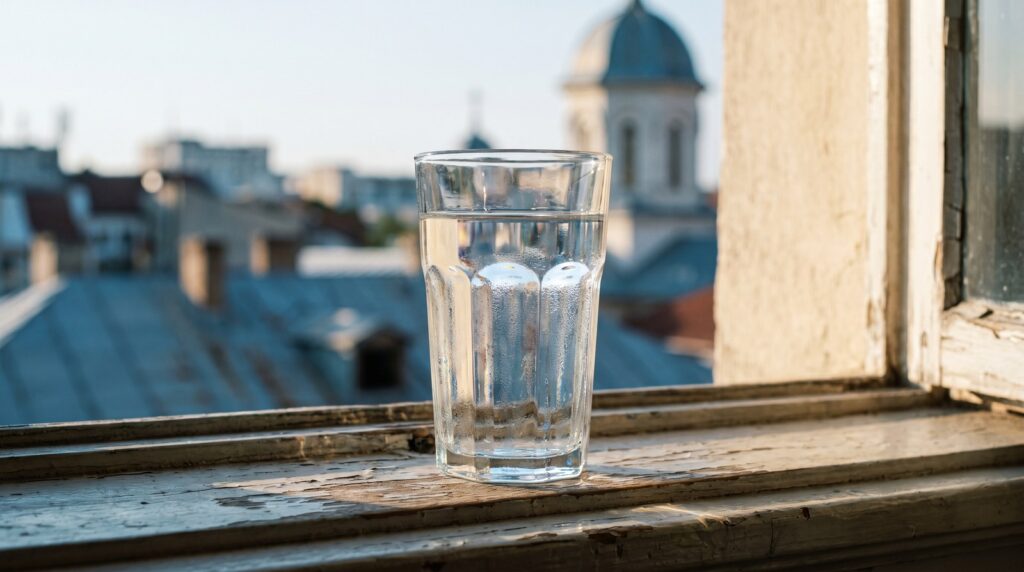
Government Ordinance No. 7 of 2023 says, in its title, exactly what it is about: the quality of water intended for human consumption. According to it, tap water coming from a public network must comply with parameters established at European level, verified by the local operator. On paper, tap water in Romania is drinking water, and the answer to the question in the title is yes.
In practice, the answer has three parts: what the law guarantees, what you taste and smell, and where your water comes from. The three don't always say the same thing, and it is precisely the difference between them that explains why more and more families in Romania are looking for a water filter for their home.
What the law says about tap water
Drinking water from the public network is regulated by Government Ordinance No. 7/2023 on the quality of water intended for human consumption, which transposes European requirements. Microbiological, chemical and indicator parameters are defined, and the water operator is obliged to monitor them.
At the European Union level, the framework is Drinking Water Directive, updated in 2020. It sets limits for substances such as lead, nitrates or pesticides and requires Member States to inform consumers about water quality.
One thing is worth understanding from the beginning: the law defines water SAFE, not water pleasant. A parameter can be within the limit and the water can still taste like chlorine. Drinking water means water that doesn't hurt you, not necessarily water that you enjoy drinking.
Who checks the water and how often?
Your local water company takes samples and analyzes them on a set schedule. The results describe the water at the outlet of the treatment plant and at points in the network.
What is not included in this check is the last part of the road: the block's column, the pipes in the apartment, the tap. There the water can take on rust, sediment or taste from an old installation, without the public network having any problems. World Health Organization stresses that water safety depends on the entire chain, from source to glass.
Potable doesn't always mean pleasant
Chlorine is the main reason. It's added during treatment to keep the water microbiologically safe throughout the network, and some of it naturally ends up in your glass. It's the very substance that gives the taste and smell that many people associate with "tap water.".
The second cause is hardness. Depending on the source, water may contain more or less calcium and magnesium salts. This is not a safety issue, but it can be seen on the resistance of the kettle and can be felt in the taste.
Both are situations where the water is legally drinkable, and at the same time, the reason why someone buys bottled water. If this is your case, we compared the two options in water filter or bottled water.
City, old block or fountain: three different situations
Public network, recent installation. The simplest case. The water is monitored, and what remains to be solved is the taste and smell of chlorine.
Public network, old block. Water enters the building within parameters, but the interior pipes can add sediment and a metallic taste. This is where filtration at the point of consumption, i.e. at the kitchen faucet, is important.
Own well or well. The water does not pass through any treatment plant and is not monitored by an operator. The responsibility for the analysis lies with the owner, and in agricultural areas nitrates can appear in the groundwater. In this case, laboratory analysis comes before any filter.
How to check the water in your home yourself
You don't need a lab for the first clues. Three things are visible to the naked eye.
The smell of chlorine when you turn on the tap, especially in the morning or after a day without running water. It's a sign that the water is treated and that some of the disinfectant has been left to reach you.
White deposits on the kettle resistance, on the shower head or on dry glasses. It shows water with more calcium and magnesium salts, i.e. harder water.
color water after an absence of several days. If the first few seconds flow yellowish or rusty, the problem is in the building's pipes, not the network.
All three are situations where the water remains potable water within the meaning of the law. If you want certainty, a laboratory analysis gives you figures for hardness, nitrates and metals. For a private well, the analysis is not optional, it is the first step.
What does a home water filter retain?
A filter mounted on the faucet acts exactly on the last stretch of the road, where public monitoring stops.
Olympus Countertop Water Filter removes chlorine, pesticides, heavy metals, asbestos fibers, hexavalent chromium, arsenic, lead, cadmium and toxic substances, while allowing mineral salts and trace elements to pass through. Filtration is done with a ceramic filter and activated carbon, with pores from 0.5 to 0.1 microns, and the manufacturer's recommendation is the 0.5 micron version.
What sets it apart from a regular filter is its antimicrobial protection: it traps pathogenic microorganisms and destroys up to 95% of the microbes inside the device within 2 hours, permanently disinfecting the internal chamber. The cartridge has a lifespan of up to 12 months or 8,000 liters, suitable for a family of up to 5 people, and the first replacement cartridge is included with purchase.
It is manufactured in Greece by Center Plus SA, with a 2-year warranty and technical support. The price is 77 €, and the GIGA variant, with a capacity of 14,000 liters, 99 €.
For rent or for a small kitchen, mini faucet filter of 27 € It attaches directly to the tap, with a replacement cartridge for €17, and retains chlorine, pesticides and heavy metals.
How to choose the right filter
It depends on the space and what you want to solve.
For most, countertop filters are the starting point: they are mounted on the tap without a plumber and without any intervention in the kitchen.
If you prefer nothing to be visible on the countertop, under-sink filters I do the same filtration with a separate tap, from 114 €.
If the analysis shows hard water or nitrates, the double and triple variants add a dedicated cartridge for limescale or nitrates. And for water with complex problems there is reverse osmosis, which I have described separately.
If you are not sure, choosing the right model It takes a minute and starts with your water.
Frequently asked questions
Is tap water in Romania safe to drink?
In the public network, yes: it is regulated by Government Ordinance no. 7/2023 and monitored by the local operator. Chlorine taste or hardness are not safety issues, but comfort issues, and are solved with a filter at the point of consumption.
Why does water taste like chlorine if it is drinkable?
Chlorine is added for disinfection and remains partially in the water until it reaches the tap. This is a sign that the water has been treated. An activated carbon filter retains it and restores the neutral taste.
What do I do if I have my own well?
Laboratory analysis is the first step, because the water is not monitored by anyone else. Depending on the result, you choose the filter: for nitrates, a dedicated cartridge; for multiple problems, reverse osmosis.
Does the filter also remove minerals from the water?
The Olympus filter allows mineral salts and trace elements to pass through. It retains unwanted substances and leaves what is beneficial in the water.
How often is the cartridge changed?
Up to 12 months or 8,000 liters on the standard model, 14,000 liters on the GIGA. The first replacement cartridge is included with purchase.
In short
Tap water from the public network in Romania is potable water according to the law and verified by the local operator. What no one can guarantee remotely is its path through your building and the taste it has in your glass. A water filter is at work there: it retains chlorine and unwanted substances, preserves minerals and, at Olympus, keeps its own interior clean.
See all Olympus antimicrobial water filters or start from frequently asked questions.