



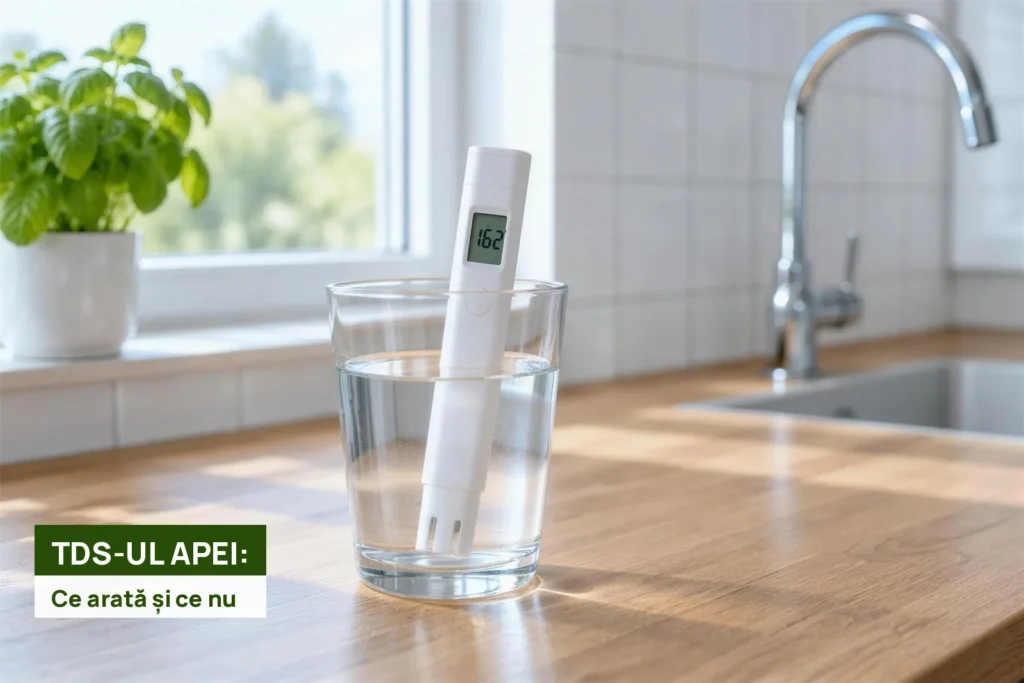
An estimate appears on the screen. A TDS meter gives you a useful value in a few seconds for tracking the content of dissolved substances, which is interpreted depending on the water tested and what you want to know.
A lower value after filtration may indicate a reduction in dissolved salts. A value close to the original value may be compatible with a filter that allows minerals to pass through. In neither case does the number alone tell you whether the water meets all the drinking water requirements.
What does TDS mean?
TDS stands for "total dissolved solids". The abbreviation comes from the English expression "total dissolved solids", and the document World Health Organization on TDS in drinking water This category includes inorganic salts and small amounts of organic matter dissolved in water.
Among the components are calcium, magnesium, sodium, and potassium, along with bicarbonates, chlorides, sulfates, and other ions. The composition differs depending on the source of the water and the minerals it comes into contact with.
A portable device estimates TDS based on electrical conductivity: it measures how well the water conducts electricity and applies a conversion factor. The result is usually displayed in ppm or mg/L. For water with typical dissolved solids concentrations, 1 ppm is approximately equal to 1 mg/L.
The composition of the water influences the conversion. The value on the screen is an estimate of the total, calculated from the conductivity, without identifying each dissolved substance.
Does a high value automatically mean unpotable water?
Minerals also contribute to TDS. A higher value may include salts that are naturally found in the water, but does not, by itself, indicate what substance caused the increase. A low value does not confirm that the water is safe to drink.
The World Health Organization (WHO) does not set a guideline value for TDS based on health effects, as the available data do not allow it to be established. This conclusion does not equate to the absence of any risk: certain substances in the total measured have their own limits and are checked separately.
Nitrates are an example. To find out their concentration, you need a specific analysis, not the total TDS value. Article about nitrates and nitrites in tap water explains the limitations and interpretation of the results.
What do TDS values have to do with the taste of water?
The World Health Organization (WHO) document presents the following taste classification, based on evaluations by groups of tasters:
| TDS (mg/L) | Taste evaluation |
|---|---|
| under 300 | excellent |
| 300-600 | good |
| 600-900 | acceptable |
| 900-1.200 | weak |
| over 1,200 | unacceptable |
The table describes the acceptability of taste. Its ranges do not represent a classification of water safety and do not replace analysis of individual parameters.
In the United States, EPA indicates 500 mg/L for TDS as part of secondary drinking water standards. These are recommendations for characteristics such as taste, color, and odor; they are not federally mandated by the EPA. The agency associates exceeding the TDS value with possible scaling, staining, or a salty taste.
The two benchmarks have different roles. Neither the EPA recommendation nor the taste scale from the WHO document can be used alone to declare a water sample drinkable or non-drinkable in Romania.
What can a TDS meter detect?
A TDS meter measures conductivity. If you dissolve a little salt in a glass, for example, the reading increases due to the ions in the water, without the result telling you that you added salt or how much of the total comes from each ion.
A TDS meter is not a test for bacteria and cannot measure lead or pesticides separately. A seemingly normal reading may coexist with substances that should be analyzed individually, at concentrations much lower than the total displayed.
For water evaluation, consult the operator's bulletins or a laboratory result. Guide Is tap water in Romania drinkable? Explain what information you find in these documents.
Why TDS may change slightly after filtration
The filter technology influences the result. A cartridge designed to retain certain substances may let through a large part of the dissolved salts, so the difference between the TDS values before and after filtration is interpreted together with the role of the cartridge and the composition of the water.
The resins used in water softening cartridges only retain calcium and magnesium salts, and the retention percentage depends on the hardness level of the water. For example, in the case of very hard water, the retention percentage will be lower than in the case of water with medium hardness.
As for TDS (Total Dissolved Solids), in addition to calcium and magnesium, it also includes many other elements, such as chlorides, nitrates, sodium, potassium, iron, etc. For this reason, resins cannot reduce all the elements that make up TDS.
Water hardness cannot be measured after using a water softener using a conductivity meter or TDS meter.
After the softener, measurements can only be made with photometers or colorimetric test kits.
This happens because, in the softening process, carbonate salts (calcium and magnesium salts) are converted into sodium salts. This process does not change the conductivity or TDS value, but it reduces the hardness of the water.
The ceramic activated carbon cartridge in the Olympus antimicrobial filters It allows the passage of mineral salts and trace elements. Its description mentions the retention of chlorine, pesticides, heavy metals, asbestos fibers, hexavalent chromium, arsenic, lead and cadmium.
Limescale resin reduces water hardness. In a multi-stage device, the result depends on the base cartridge and the additional ones, and TDS and hardness are tracked separately, as they are different parameters.
Reverse osmosis reduces dissolved salts. to Olympus reverse osmosis system, the third stage membrane retains, according to the product description, calcium and magnesium salts, nitrates and salts from brackish water. Guide about reverse osmosis for home presents the operating stages.
Start with water analysis. To choose a filter, the model data must correspond to the substances you want to reduce, information that a TDS target chosen in isolation cannot provide.
How to track cartridge maintenance
Track usage time and consumption. For a cartridge that lets minerals through, a TDS value close to that of tap water does not determine when to replace; it depends on the time and volume limits in the instructions.
For the standard Olympus ceramic cartridge, the declared capacity is up to 8,000 liters or 12 months, whichever comes first. The instructions recommend replacing it no later than 10-12 months after commissioning, even if the maximum volume has not been consumed.
Note the installation date. Our company sends you a notification when the time for replacement is approaching. The ceramic cartridge is cleaned every 3-4 months or when the flow rate decreases noticeably, and if the flow rate does not return after cleaning, it may be necessary to replace it earlier.
When your device is useful
Compare the same water source over time. Used as directed, a TDS meter allows you to track variations in the conductivity of that source, without identifying the substance or cause that led to the change in value.
Check the instructions for your reverse osmosis system. Comparing the incoming water to the filtered water can help track salt reduction, interpreting the result according to the system's instructions and checking other water parameters separately.
For choosing and using a filtration device, consult also the 7 criteria for a good water filter.
Frequently asked questions
Is there a TDS value that confirms that the water is drinkable?
There is no single TDS value that confirms drinkability. TDS describes an estimated total dissolved solids. Water quality is assessed by analyzing individual parameters, including microbiological ones.
Does the TDS meter detect bacteria or lead?
The TDS meter measures the conductivity of the water. It converts it into an estimate of the TDS, which cannot be used as a test for bacteria or lead concentration. These parameters require specific analysis.
Why can TDS remain close after a Olympus filter?
The ceramic activated carbon cartridge in the antimicrobial range allows mineral salts and trace elements to pass through. The TDS value does not show separately which substances the cartridge has retained. In multi-stage models, the result also depends on the additional cartridges.
What type of filter reduces dissolved salts?
Reverse osmosis reduces dissolved salts. The Olympus system has four stages, costs €250, and uses a membrane in the third stage that retains calcium and magnesium salts, nitrates, and salts in brackish water, according to the product description.
What does ppm mean on a TDS meter?
Ppm stands for parts per million. For water with typical dissolved solids concentrations, 1 ppm is approximately equal to 1 mg/L. The value displayed by a portable TDS meter is estimated from the conductivity of the water.
Use measurement in conjunction with water analysis
The TDS meter is useful for monitoring a parameter. The analysis report shows you what substances are in the water and in what concentrations. With this information you can compare Olympus antimicrobial filters and other systems, depending on the filtration you need.